
Ebola Outbreak in DRC: Symptoms, Management & Homoeopathy as Supportive Care
Ebola in the Democratic Republic of Congo is a serious public health concern that requires early awareness, timely medical care, isolation, hydration, and coordinated public health response. This article explains Ebola symptoms, how it spreads, standard medical management, and the supportive role homoeopathy may play as an adjunctive, individualized approach under qualified supervision.
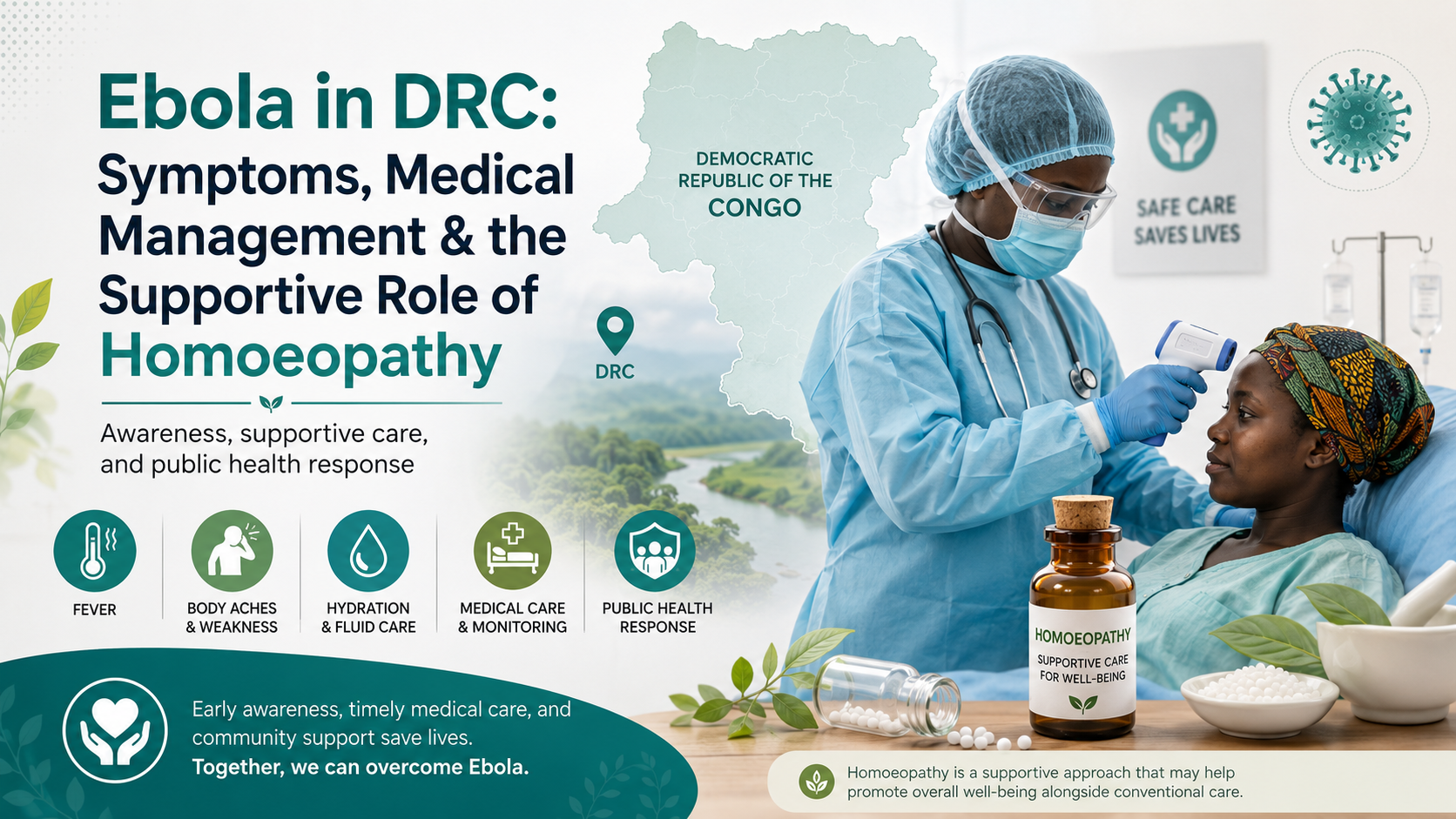
Public Health • Ebola Awareness • Supportive Care
Ebola disease in the Democratic Republic of the Congo is a serious public health emergency. This article explains the symptoms, transmission, medical management, and the responsible role homoeopathy may play as adjunctive symptom-support under qualified supervision, without replacing isolation, testing, rehydration, emergency care, or WHO-recommended outbreak response.
Ebola in DRC: why public awareness matters
Ebola disease is a rare but severe viral illness caused by viruses of the Orthoebolavirus genus. It can become life-threatening quickly, especially when patients reach care late, are dehydrated, develop shock, or have bleeding complications. The Democratic Republic of the Congo has a long history of Ebola outbreaks, and the first documented Ebola outbreak was reported in 1976 in the area now known as DRC.
Current public health updates have highlighted Bundibugyo virus disease activity affecting DRC and Uganda. WHO has stated that the Bundibugyo species involved in the 2026 outbreak does not currently have an approved vaccine or specific treatment, although candidate treatments and vaccines are being studied. This makes early detection, isolation, supportive care, contact tracing, infection prevention, and community trust extremely important.
Sources: WHO Ebola disease fact sheet, WHO DRC 2026 outbreak update, ECDC outbreak update.
How Ebola spreads
Ebola does not spread like common flu or COVID-19. It is not mainly an airborne infection. Transmission usually happens through direct contact with blood or body fluids of a person who is sick or has died from Ebola, or through contaminated bedding, needles, medical equipment, clothing, or unsafe burial practices.
People at higher risk include:
- Healthcare workers without adequate personal protective equipment.
- Family members caring for a sick person at home.
- People involved in unsafe handling of the body of a person who died from suspected Ebola.
- Contacts of a confirmed or suspected case during the 21-day monitoring period.
Public education must be respectful and community-led. Fear, stigma, and misinformation can delay care and increase spread. The safest message is simple: report symptoms early, avoid contact with body fluids, do not hide illness, and cooperate with trained health teams.
Ebola symptoms: early warning signs and severe symptoms
Ebola symptoms may appear from 2 to 21 days after exposure. The early stage may look like many common infections, which is why travel history, contact history, and local outbreak alerts are important.
Early “dry” symptoms
- Sudden fever
- Severe weakness and fatigue
- Headache
- Muscle and joint pains
- Sore throat or difficulty swallowing
Later “wet” symptoms
- Vomiting
- Diarrhoea, sometimes with blood or mucus
- Loss of appetite
- Skin rash
- Unexplained bleeding from gums, nose, vomit, stool, or injection sites
Sources: CDC Ebola basics, ECDC Ebola Q&A.
How Ebola is medically managed
Ebola management is urgent and must be done through trained medical and public health teams. The first priorities are rapid identification, safe isolation, laboratory confirmation, infection prevention, hydration, correction of electrolyte imbalance, and treatment of complications.
Core medical management includes
- Isolation and infection control to prevent spread to family members, healthcare workers, and the community.
- Fluids and electrolytes by mouth or intravenously to manage dehydration from vomiting and diarrhoea.
- Blood pressure and oxygen support when shock, hypoxia, or severe weakness develops.
- Control of vomiting, diarrhoea, fever, and pain through appropriate medical care.
- Treatment of co-infections such as malaria, bacterial infection, or other locally common illnesses.
- Clinical trials where available for candidate treatments, especially when the Ebola species has no approved specific therapy.
WHO recommends monoclonal antibody treatments for Ebola virus disease caused by Orthoebolavirus zairense, but for Bundibugyo virus disease there is currently no approved vaccine or specific treatment. Therefore, supportive care and outbreak control remain central.
Sources: WHO treatment guidance, CDC clinical guidance.
Where homoeopathy may fit: a responsible adjunctive model
Homoeopathy is a system of medicine where the prescription is selected according to the patient’s total symptom picture, physical state, mental state, modalities, thirst, restlessness, collapse tendency, bleeding pattern, and individual response to illness. In epidemic situations, classical homoeopathy also studies the common symptom-pattern across many patients, often called the genus epidemicus.
In Ebola, homoeopathy should not be presented as a standalone treatment, cure, prevention, replacement for isolation, or alternative to emergency care. A scientifically responsible proposal is to evaluate homoeopathy only as adjunctive symptom-support alongside standard medical management, with ethics approval, documentation, safety monitoring, and public health oversight.
Potential supportive goals of homoeopathy
- Comfort support for fever, anxiety, restlessness, body pains, weakness, nausea, vomiting, diarrhoea, and exhaustion.
- Individualized care for patients who are already under institutional medical supervision.
- Supportive care for convalescence after discharge, where approved by treating doctors.
- Research documentation to understand whether adjunctive homoeopathy changes patient comfort, recovery markers, or supportive-care needs.
Homoeopathic medicines are commonly used in highly diluted doses and are generally considered gentle when prescribed correctly. However, in an Ebola outbreak, no medicine should be distributed or advertised as “Ebola prevention” or “Ebola cure” unless supported by appropriate regulatory approval and clinical evidence.
Homoeopathy in previous epidemics: historical and clinical context
Homoeopathy has historically been discussed in relation to epidemic illnesses such as cholera, Spanish influenza, yellow fever, scarlet fever, diphtheria, typhoid, dengue, chikungunya, Japanese encephalitis, and COVID-19. In India, CCRH documents discuss the concept of genus epidemicus and describe homoeopathy as an add-on to usual care in selected epidemic settings such as dengue and acute encephalitis syndrome/Japanese encephalitis.
For COVID-19, some studies explored individualized homoeopathy as an adjunct to standard care. These findings should not be directly transferred to Ebola because Ebola has a different mode of transmission, clinical severity, case-fatality profile, and outbreak-control requirements. The right way forward is not overclaiming, but structured collaboration, documentation, and ethical evaluation.
Sources: CCRH COVID-19 homoeopathy fact sheet, COVID-19 adjunctive homoeopathy study.
Frequently discussed homoeopathic medicines in severe infectious states
The following medicines are mentioned only for academic and professional discussion. They should not be used for self-treatment, public distribution, or as an Ebola protocol without examination, case-taking, and approval from appropriate health authorities.
| Medicine | Traditional symptom picture often studied | Responsible use statement |
|---|---|---|
| Crotalus horridus | Haemorrhagic tendencies, dark bleeding, septic states, profound weakness. | Only under qualified homoeopathic supervision as adjunctive consideration. |
| Arsenicum album | Restlessness, anxiety, exhaustion, burning sensations, vomiting, diarrhoea, thirst in small sips. | Should not be promoted as Ebola prevention or cure. |
| Lachesis | Toxic states, dark discharges, sensitivity to touch, left-sided complaints, aggravation after sleep. | Requires individualization and clinical monitoring. |
| Baptisia | Typhoid-like states, dullness, body ache, prostration, offensive discharges. | Academic mention only; not an Ebola-specific treatment claim. |
| Carbo vegetabilis | Collapse-like weakness, coldness, air hunger, low vitality, exhaustion after fluid loss. | Emergency shock requires oxygen, fluids, and intensive medical care. |
| Cinchona officinalis | Weakness after loss of fluids, diarrhoea, dehydration tendency, exhaustion. | Oral/IV rehydration and electrolyte correction must never be delayed. |
Clinical caution:
Ebola can deteriorate rapidly. Fever, vomiting, diarrhoea, bleeding, confusion, breathlessness, severe weakness, or suspected exposure must be handled as a medical emergency. Homoeopathy must never delay transfer to an Ebola treatment centre.
A public-health proposal: how homoeopathy can be evaluated ethically in DRC
For a public health department, the most credible approach is not to claim that homoeopathy “treats Ebola,” but to propose a supervised, transparent, adjunctive-care model that respects national and WHO protocols.
1. Work inside treatment centres
Homoeopathic support, if approved, should be offered only alongside standard Ebola treatment and infection-control systems.
2. Document outcomes
Track comfort scores, vomiting frequency, diarrhoea frequency, hydration needs, fever pattern, recovery time, adverse events, and survival outcomes.
3. Maintain ethical language
Use “adjunctive symptom-support” and “research evaluation,” not “Ebola cure,” “guaranteed prevention,” or “replacement treatment.”
This creates a safer bridge between traditional community trust and modern outbreak response. It also protects patients from false reassurance while allowing serious evaluation of supportive integrative care.
What families should do if Ebola is suspected
- Do not hide symptoms or manage the patient at home.
- Avoid direct contact with blood, vomit, stool, saliva, sweat, urine, semen, vaginal fluid, bedding, or clothing of a suspected case.
- Call local health authorities or the nearest Ebola response team immediately.
- Do not touch the body of a person who has died from suspected Ebola.
- Cooperate with contact tracing and 21-day monitoring after exposure.
- Use only medicines advised by qualified healthcare providers and do not delay emergency treatment.
Final perspective
Ebola needs speed, trust, and coordinated medical action. The strongest public health approach combines early reporting, safe isolation, laboratory testing, optimized supportive care, contact tracing, community engagement, and clinical research where specific treatments are not yet approved.
Homoeopathy may be explored as a gentle, individualized, adjunctive symptom-support system only when it is integrated responsibly with standard care and monitored ethically. It should never be used to replace emergency treatment, infection-control measures, hydration, oxygen support, blood pressure management, or clinical trial access.
A responsible message from Dr. Shweta’s Homoeopathy
Our approach supports safe, ethical, individualized care. In severe infectious diseases like Ebola, homoeopathy must be considered only as complementary support under qualified supervision and never as a substitute for public health protocols or emergency medical treatment.
References
- World Health Organization: Ebola disease fact sheet
- World Health Organization: Ebola outbreak — DRC 2026
- CDC: Ebola disease basics
- CDC: Clinical guidance for Ebola disease
- ECDC: Ebola disease outbreak in DRC and Uganda
- CCRH: Homoeopathy in COVID-19 coronavirus infection fact sheet
- Nayak et al.: Individualized homoeopathy as adjunct to standard care in COVID-19
Consult Dr. Shweta
Book an in-clinic or online consultation for personalised homeopathic care.
Request Appointment