
Homoeopathy for Patellar Tendinitis: Natural Relief for Jumper's Knee in Athletes
Discover how homoeopathy manages patellar tendinitis (jumper's knee) — reducing inflammation, easing pain, and supporting tendon healing so athletes can keep performing.
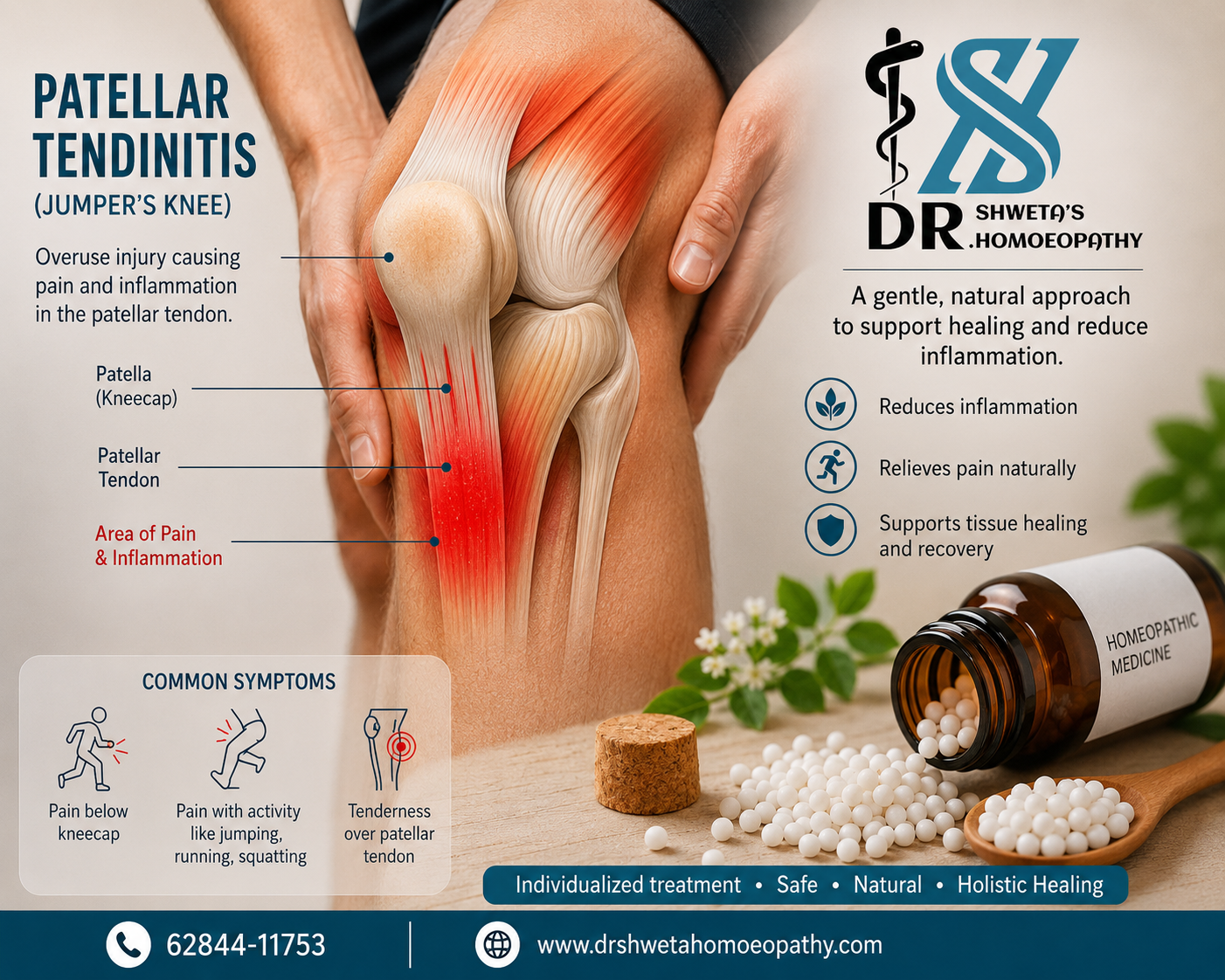
How Do We Manage Patellar Tendinitis With Homoeopathy?
A nagging pain just below the kneecap can quietly end an athlete's season. Here's how homoeopathy works alongside rest and rehabilitation to calm inflammation, ease pain, and help the tendon truly heal.
What Is Patellar Tendinitis?
Patellar tendinitis, commonly called "jumper's knee," is the irritation and inflammation of the patellar tendon — the thick band of tissue that connects your kneecap (patella) to your shinbone (tibia). This tendon does the heavy work of straightening the knee every time you jump, run, squat, or land. When it is overloaded again and again without enough recovery, tiny tears develop, and the tendon becomes painful, tender, and stiff.
Left unaddressed, what begins as a mild ache after activity can slowly turn into a persistent, performance-limiting problem.
Who Gets Patellar Tendinitis Easily?
Some people are far more prone to it than others. You are at higher risk if you are:
- Jumping-sport athletes — basketball, volleyball, high jump, and long jump players whose knees absorb repeated landing forces.
- Runners and sprinters, especially those who suddenly increase mileage or intensity.
- Footballers, cricketers, and badminton players who do explosive starts, stops, and direction changes.
- People who train on hard surfaces or with poor footwear, tight thigh muscles, or weak hips.
- Anyone with sudden training overload — a rapid jump in workout volume without proper conditioning.
What Are the Symptoms? Which Movements Hurt?
The hallmark of patellar tendinitis is a focused pain at the front of the knee, right below the kneecap. The pain is movement-dependent — certain actions reliably make it worse:
- Jumping and landing — the single most aggravating movement.
- Squatting or kneeling, which loads the tendon under a deep bend.
- Climbing or descending stairs, particularly going down.
- Running, sprinting, or sudden stops.
- Standing up after sitting for a long time, when the knee feels stiff and sore.
Early on, the pain appears only after activity. As it progresses, it shows up during activity and may linger even at rest. You may also notice tenderness on pressing just below the kneecap, mild swelling, and stiffness in the morning.
How Is It Diagnosed?
Diagnosis usually begins with a clinical examination — your doctor checks the exact site of tenderness and which movements reproduce the pain. To confirm and assess severity, basic investigations are used:
- Ultrasound — a quick, accessible scan that shows tendon thickening and tears.
- MRI — the most detailed view, used to grade the degree of tendon damage and rule out other causes when the picture is unclear or the problem is long-standing.
These help distinguish simple inflammation from deeper degenerative changes, which guides how aggressively the condition needs to be managed.
The Foundation: Rest, Physiotherapy & Strength Training
No tendon heals without managing its load. The cornerstone of recovery is always:
Rest & activity modification — reducing the jumping and high-impact load that caused the problem, so the tendon gets a chance to recover.
Physiotherapy — guided exercises, stretching of tight quadriceps and hamstrings, and techniques to correct movement patterns.
Strength training — progressive loading (especially eccentric exercises) that rebuilds a stronger, more resilient tendon over time.
Where Homoeopathy Fits In — Especially for Athletes
Rest and rehabilitation work — but they take time, and that is precisely the challenge for a competitive athlete who needs to keep performing. This is where homoeopathy becomes a valuable partner alongside physiotherapy.
Homoeopathic medicines, chosen for the individual, can help to:
- Reduce inflammation and swelling around the tendon.
- Ease pain, so the athlete can train and compete with less discomfort.
- Support and speed up the natural healing of the tendon tissue.
- Do all of this gently and without the side effects often associated with long-term painkillers.
For someone who cannot simply stop their sport, a remedy that calms the inflammation and supports repair — while physiotherapy strengthens the tendon — can make a real difference to both comfort and recovery.
A Holistic, Individualized Approach
Classical homoeopathy does not treat "the knee" alone — it considers the whole person: how the pain behaves, what makes it better or worse, the body's healing tendency, and the demands of the sport. The remedy is selected to match the individual, which is why two athletes with the same diagnosis may receive different prescriptions.
The Takeaway
Patellar tendinitis is a manageable condition when addressed early and sensibly. Confirm it with a proper examination and, where needed, an ultrasound or MRI. Respect the basics — appropriate rest, physiotherapy, and progressive strength training. And for the athlete who must stay in the game, homoeopathy offers a safe, supportive way to reduce inflammation, control pain, and encourage genuine tendon healing.
Struggling with knee or tendon pain?
A personalized homoeopathic consultation can help you heal naturally — without slowing down your goals.
This article is for informational purposes only and is not a substitute for professional medical advice. Please consult a qualified practitioner for diagnosis and treatment.
Consult Dr. Shweta
Book an in-clinic or online consultation for personalised homeopathic care.
Request Appointment